
Digital forms
No more paper
E-signed
Stored with the PDF
Self-service
Patient check-in
Auto-filed
Stored instantly
Secure records
Stored with the patient
Flexible
Configure per treatment
PDF ready
Generated on sign
Digital consent forms for South African practices
Patients complete consent on a tablet in the waiting room, or on their phone before they arrive. Every signed form becomes a PDF in that patient's record.

One form.
Every field.
Dynamic forms adapt to each patient and treatment type. Required fields, conditional logic, and built-in validation ensure nothing is missed.
Signed. Stored. Sorted.
Every completed form is automatically archived as a PDF, linked to the patient record, and backed up to the cloud.

Auto PDF
Every signed consent form becomes a branded PDF the moment the patient finishes, ready to file, print, or share.

Cloud backup
Archived forms sync to secure cloud storage automatically, so your records stay protected without manual filing.

Patient linking
Each PDF attaches to the correct patient record instantly, so consent history is always one tap away.
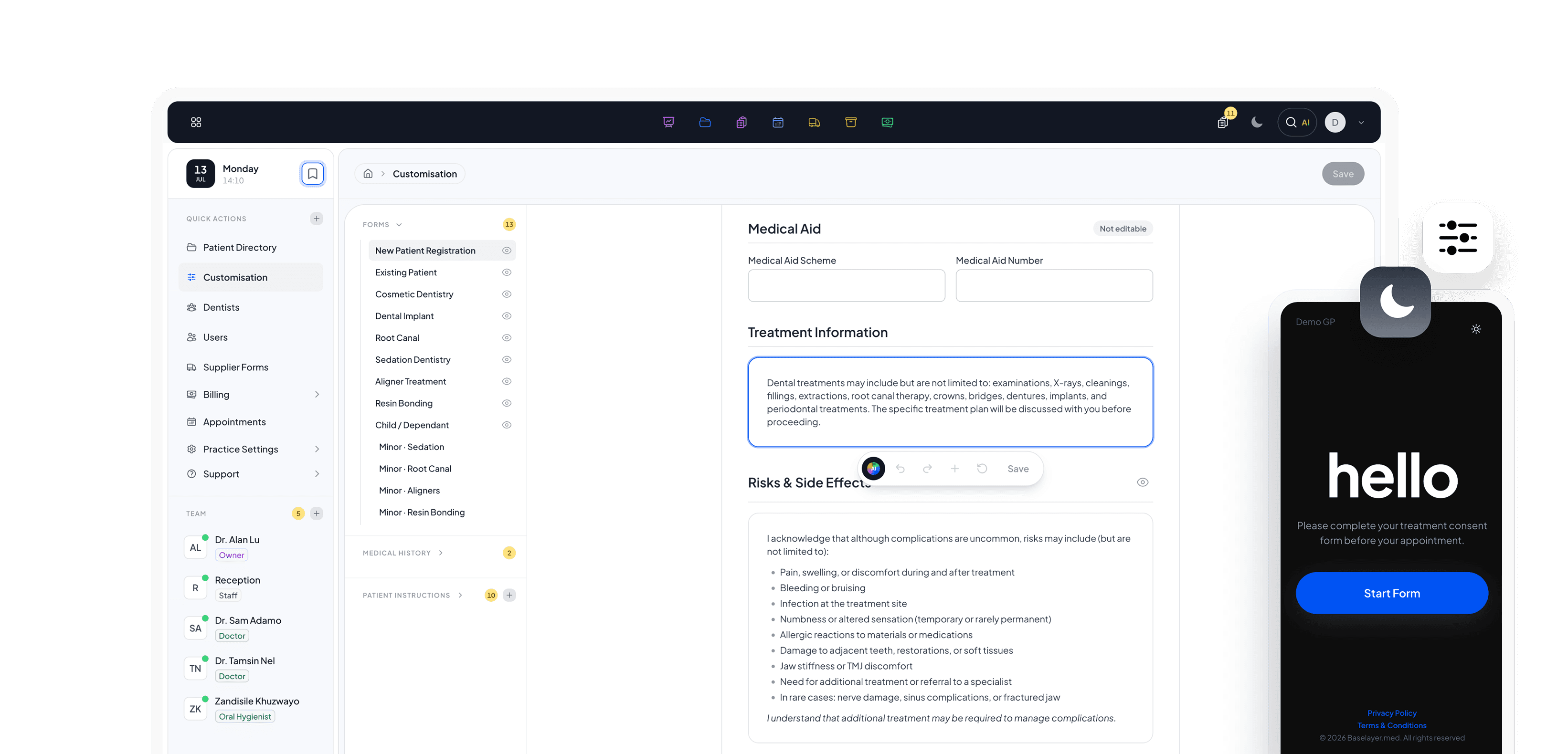
Make every form yours.
Rewrite copy, toggle fields on or off, and tailor bullet points per treatment type. What you edit in Customisation is exactly what your patients see on the kiosk.

Inline editing
Rewrite headings, copy, and bullet points directly in the editor, changes reflect instantly on the patient kiosk.

Toggle fields
Switch individual fields on or off per form so patients only see what is relevant to their visit.

Per treatment
Tailor consent copy and field sets for each treatment type from one central place, no duplicate templates.
Digital consent
Ready to retire
the clipboard?
Replace clipboards, photocopied indemnity forms and scanned signatures with consent forms your patients complete on a tablet in the waiting room, or on their own phone before they arrive.
Every signed form becomes a PDF in that patient's record, without anyone scanning or filing it. Baselayer.med is an all-in-one practice platform built in South Africa for dentists, GPs, physiotherapists, psychologists, chiropractors, biokineticists, aesthetic practitioners, anaesthetists and cardiac physiologists. Digital consent forms are included in every plan, alongside the appointment book, clinical notes, scripts and referrals, and accounting.
How it works
How digital consent works in Baselayer.med
- 01Choose or build the form
Start from a template for your profession, or build your own. Turn fields on or off, rewrite headings and bullet points, and set different consent wording for each treatment type.
- 02Get it to the patient
The patient completes it on their own device before the appointment, or on a tablet at reception in kiosk mode.
- 03The patient completes and signs
Required fields and conditional logic mean the form adapts to the patient and the treatment, and it can't be submitted half-done. The patient signs on screen.
- 04It's filed automatically
Baselayer.med generates a branded PDF, attaches it to the patient record and backs it up to cloud storage.
What's included
Dynamic forms
Conditional logic, required fields and built-in validation.
Per-treatment wording
Tailor the consent text and field set for each procedure or service type.
Kiosk mode
Lock a reception tablet to the form screen.
E-signatures
Patients sign on screen, and the signature is stored with the signed PDF. Electronic signatures are recognised under the ECT Act. Read more about e-signatures.
Automatic PDF and patient linking
Every signed form is saved to the patient file. See patient records.
Cloud storage
Forms are stored in encrypted cloud storage and can be opened from a device your team is logged in on.
Patient intake in the same flow
Capture personal details, medical aid details and medical history once.
Consent forms for every profession
Baselayer.med ships profession-specific templates you can edit. The templates are a starting point. You remain responsible for the clinical and legal content of your forms.
- DentistsDental indemnity, treatment consent, medical history.
- GPsGeneral consent, medical history, telehealth consent.
- PhysiotherapistsRehab consent and intake.
- BiokineticistsRehab consent and intake.
- ChiropractorsChiropractic consent and intake.
- Cardiac physiologistsProcedure consent covering ECG, echo, ambulatory monitoring, stress testing and device checks.
- PsychologistsClient consent, limits of confidentiality, telehealth opt-in.
- AnaesthetistsAnaesthetic consent covering sedation and general anaesthetic risks, and fasting status.
- Aesthetic practitionersTreatment consent, off-label use, photography permission.
Paper vs digital consent
Paper forms
Baselayer.med digital forms
Completing
PaperClipboard in the waiting room
DigitalPatient's phone before arrival, or a reception tablet
Legibility
PaperHandwriting varies
DigitalTyped answers
Missing fields
PaperFound later, if at all
DigitalRequired fields block submission
Filing
PaperScan, name and file manually
DigitalPDF linked to the patient record
Updating wording
PaperReprint every form
DigitalEdit once; the next patient sees the change
Consent is a conversation, not just a signature
A digital form makes consent easier to capture, but it does not replace the consent discussion. South Africa's National Health Act (61 of 2003) requires health care providers to inform patients about their health status, the treatment options, the benefits, risks, costs and consequences of each option, and their right to refuse (section 6). Treatment generally needs the patient's informed consent (section 7).
The HPCSA's ethical guideline Seeking patients' informed consent: the ethical considerations (Booklet 4) describes informed consent as an ongoing dialogue. Use the form to record what was explained and agreed, and keep your clinical note of the discussion in the same patient record.
E-signatures and South African law
South Africa's Electronic Communications and Transactions Act (25 of 2002) recognises electronic signatures. An electronic signature is not without legal force merely because it is electronic. Where a law requires a signature without specifying the type, an advanced electronic signature may be required. Whether a specific consent form needs a particular kind of signature depends on the procedure and the law that applies. Take advice on your own forms.
POPIA and your consent records
Health information is special personal information under the Protection of Personal Information Act (POPIA). Signed forms are stored in the patient's record. Staff access is through individual logins. A data processing agreement sets out Baselayer.med's role as your operator. See our DPA.
Read how to go paperless in a South African private practice.
Switching from paper or another system
Patient data migration imports patient records from a CSV export of your current software. Your new consent forms then attach to those patients.
Pricing
Practice
R2 499/month
4 clinicians, admin staff free, every feature.
Solo
R899/month
Any 3 users, every feature.
Both start with a 30-day free trial. See pricing.
Frequently asked questions
Can patients complete consent forms on their own phone?
Yes. Patients can complete and sign on their own phone before the appointment, or on a reception tablet in kiosk mode.
Where are signed consent forms stored?
Each signed form is saved as a PDF in the patient's record in Baselayer.med and backed up to encrypted cloud storage. You can open it from any device your team is logged in on.
Are electronic signatures valid in South Africa?
The ECT Act recognises electronic signatures. Where a law specifically requires a signature without saying which type, the Act requires an advanced electronic signature. Requirements differ by situation, so check with your professional body or legal adviser for your specific forms.
Can I use my own consent wording?
Yes. Edit headings, text and bullet points, switch fields on or off, and set different wording per treatment type. What you edit is exactly what the patient sees.
Do digital consent forms replace the consent conversation?
No. The HPCSA describes informed consent as a dialogue with the patient. The form records what was explained and agreed. Keep your clinical notes as usual.
Which professions are the templates for?
Dentistry, general practice, physiotherapy, biokinetics, chiropractic, cardiac physiology, psychology, anaesthetics and aesthetics.
Is it included in my plan?
Yes. Digital consent forms are included on the Practice (R2 499/month) and Solo (R899/month) plans, with a 30-day free trial.
Can I bring my existing patients across?
Yes. Import patients from a CSV export of your current system using patient data migration.
Explore more solutions
Every feature works together as part of one connected platform.